
To summarize 2020, it could simply be said, “Phew. It’s very good to have that done with.” There were incredible upheavals in politics, race relations and human health, but it was also a tumultuous year in East Bay real estate (admittedly this topic pales in importance to the others, but it still bears addressing).
We’ve heard the stories of how the market fell off a cliff when shelter-in-place went into effect (sales were down 53% in May compared to 2019). We may have also heard that the market has steadily been recovering since then, peaking at an all-time high in sales and median price. But now the question stands: where did we end up for the year, and how is 2021 shaping up?
To best understand the seismic shift of 2020, think back to where we were in 2018 and 2019: sellers were preferring to update their homes rather than move out, and buyers were getting exhausted by the low inventory, competition and high prices. As a result, prices were plateauing and the number of sales was decreasing. At that pace, the market would have eventually started to deflate.
But then came 2020. As families worked and schooled from home, there was a big jump in “move up” sellers who needed more space. This drove sales to a 3% decline over 2019, a significant improvement over the “cliff” that we faced earlier in the year and consistent with the slow decline in sales since 2017.
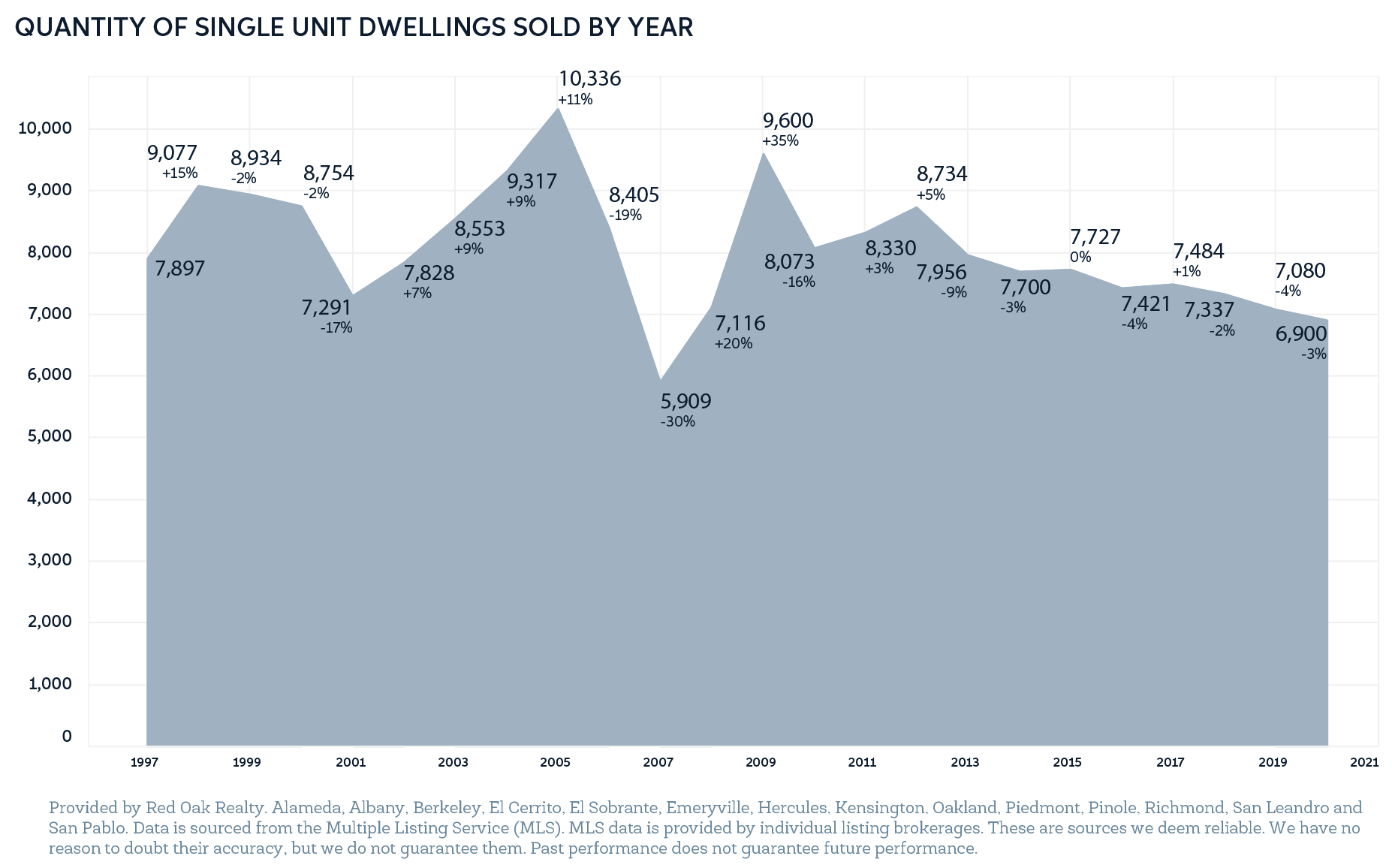
As a result of buyers looking for larger properties, homes that have a yard were in greater demand than those without (with yard sold an average of 9.9% over list, without yard sold 7.9% over list), and homes with 4 bedrooms appreciated twice as fast as those with 3 bedrooms (an average of 18% for 4 bedrooms and 8% for 3 bedrooms, 2019 vs. 2020). Similarly, single-family homes were in higher demand than condos (condos sold an average of 1.7% over list, single-family properties sold 10.7% over list). We also saw a high number of sellers move out of the Bay Area entirely, with many Red Oak sellers moving to Sacramento, Oregon and Washington.
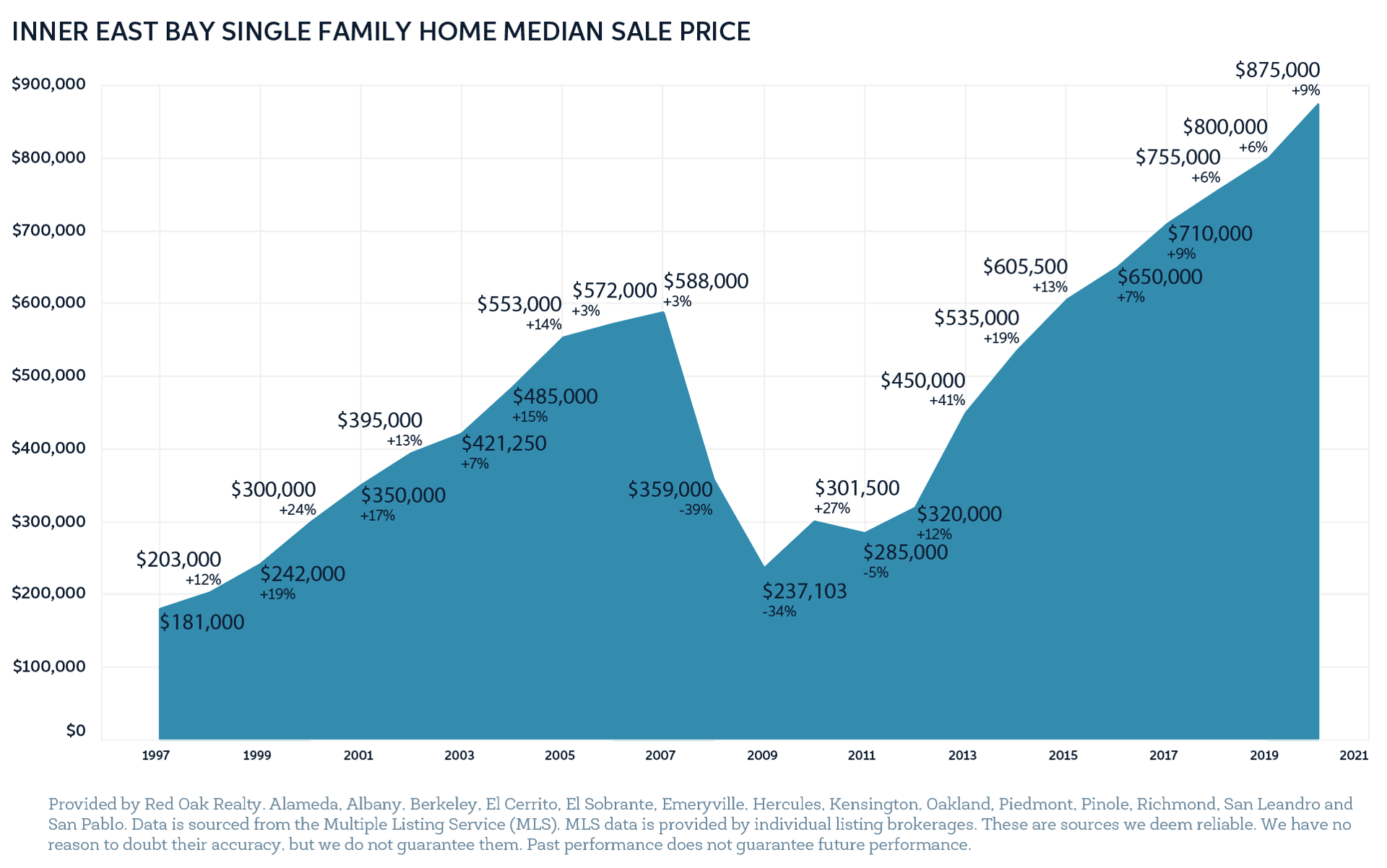
This higher level of seller activity kept inventory at record-high levels (at the end of December, there were more active listings than any time since Red Oak started tracking in 2012). Even though buyers finally had more supply to choose from, the inventory wasn’t enough to meet the demand, which pushed 2020 median prices to an all-time high of $875,000, a 9% increase over the previous year.
So where does this leave us for 2021? Since September to December broke records going back 10 years and properties under contract were at their highest level in 5 years, January and February should be much more active than usual. Going forward, we suspect that inventory will remain high as people look to sell and Prop 19 spurs activity. Sales will not follow traditional seasonal patterns and hopefully, buyer demand and consumer confidence will remain aloft.
Even during the financial crisis of 2008 there was still demand for properties that had the right look, the right price, and were in the right location. In 2021, sellers should follow similar behavior, fixing up their property and pricing low to attract the widest range of buyers. Buyers should be prepared to move quickly, possibly use pre-emptive offers (which are becoming more common), and keep an open mind when looking for their home: all purchases require some compromise (yes, even for multi-million dollar properties), so you might need a little more creativity and patience to take a diamond in the rough and make it yours.
Reach out if you want to know how to best be prepared for 2021.